Battle of the Delaware Beach State Park Campgrounds!!
Cape Henlopen vs. Delaware Seashore State Park: Which Delaware Beach Campground Is Right for Your RV?
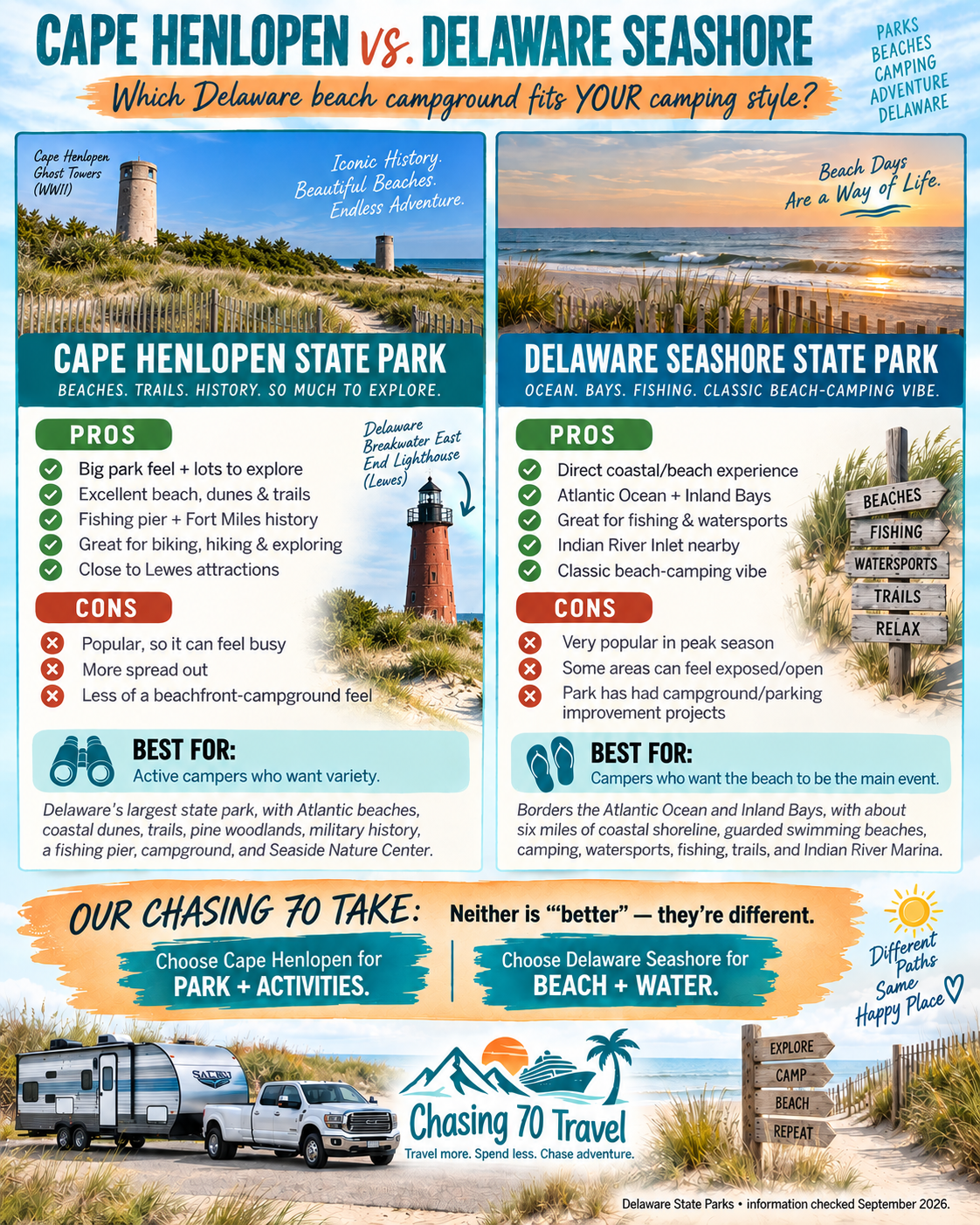
If you’ve spent any time in camping groups, you’ve probably seen the question:
“Which is better — Cape Henlopen or Delaware Seashore State Park?”
We’ve camped at both, and here’s the thing:
These aren’t really two versions of the same camping experience.
Both parks put you on Delaware’s beautiful coast. Both offer beaches, fishing and plenty to do. Both are popular with RV campers. But once you pull into the campground, the experience is surprisingly different.
One puts you in a wooded campground with big sites, shade and more privacy. The other gives you full hookups, easy access to the beach and Indian River Inlet — but you’re also camping in a very open, exposed environment with little privacy.
So which one should you choose? Well…
It depends on what kind of camping you like. And if you have enough time? We say camp at both.
🌲 Cape Henlopen State Park
The Campground: Trees, Shade and Space
Cape Henlopen State Park is located near Lewes, Delaware, and encompasses a huge variety of coastal environments.
There are Atlantic Ocean beaches, Delaware Bay, dunes, maritime forests, trails, fishing areas and historic military sites. The park is also home to Fort Miles and the Seaside Nature Center. (Delaware State Parks)
But let’s start with the thing you’ll notice when you pull into the campground:
It’s wooded. There are trees throughout the campground, and the sites feel large and separated.
Compared with Delaware Seashore, Cape Henlopen has a much more traditional “we’re camping” feeling. You have shade. You have trees. You have some privacy. And you aren’t staring directly into your neighbor’s campsite from the moment you step outside.
For us, that matters.
🚐 RV Hookups at Cape Henlopen
Cape Henlopen offers water and electric hookups, but there is no sewer connection at the individual campsite. The campground includes 30 and 50 amp electrical service, and campers have access to a dump station. (Delaware State Parks)
This is very common amongst state parks, and for some RVers, that’s perfectly fine. For others, the lack of sewer hookups may be a deal breaker. And that’s one of the biggest differences between these two campgrounds.
👍 The Pros of Cape Henlopen
🌲 A wooded campground
This is probably our biggest advantage for Cape Henlopen. The trees provide shade and create a much more private camping environment.
📏 Big-feeling sites
The campsites feel spacious, and the trees make the campground feel less crowded.
🚲 Lots and lots of trails
Cape Henlopen has an extensive trail system, with more than 19 miles of trails throughout the park. (Delaware State Parks)
You can borrow bikes. You don’t necessarily have to rent a bike or haul your own. Grab a bike and go explore.
🐢 Don’t Skip the Seaside Nature Center
If you’re camping at Cape Henlopen — especially if you’re traveling with kids or grandkids — put the Seaside Nature Center on your list.
This isn’t just a building with a few displays. The Nature Center features aquariums and exhibits highlighting Delaware’s coastal environment and native wildlife, along with a marine touch tank. (Delaware State Parks). And the touch tank can be a huge hit with kids.
Our granddaughters absolutely love getting to touch some of the animals. They’ve interacted with clearnose skates, hermit crabs and horseshoe crabs, and what’s available can vary depending on the animals being featured when you visit.
Clearnose skates are especially interesting because they’re a local species. DNREC identifies the clearnose skate as Delaware’s most common skate and notes that they occur in Delaware Bay, the Atlantic Ocean and the Inland Bays. (Delaware DNREC)
And then there’s the horseshoe crab. They may look prehistoric, but they’re an incredibly important part of the Delaware Bay ecosystem. Delaware Bay supports the world’s largest concentration of spawning horseshoe crabs, and their eggs provide an important food source for migrating shorebirds. (Delaware DNREC). It’s one thing to read about the local ecosystem. It’s another thing to let your granddaughter touch it.
🌿 Gordons Pond
Another Cape Henlopen feature worth exploring is Gordons Pond.
Gordons Pond is a coastal pond and wildlife area within Cape Henlopen State Park, surrounded by dunes, marsh and coastal habitat. It’s a completely different environment from the ocean beach.
The area is popular for hiking and biking, and it’s a great place to look for wildlife and birds. And once again, having access to bikes makes this particularly fun. You can leave your campsite, borrow a bike at the Nature Center and explore the park without ever getting in the truck.
That’s a pretty great camping day.
🏄 Surfing at Cape Henlopen
Cape Henlopen has surfing, too.
Herring Point is one of the places where you can go watch surfers. We aren’t surfers, so we’re not going to pretend we can evaluate wave quality. But we’ve watched surfers at both parks, and our personal observation is that Indian River Inlet at Delaware Seashore seems to have a stronger surfing scene.
Cape Henlopen absolutely has surfers. We just haven’t personally seen the same level of surfing activity there that we’ve seen at Indian River when the surf is up.
🏖️ The Pros of Cape Henlopen — Quick List
- 🌲 Wooded campground
- ☀️ More shade
- 📏 Large-feeling sites
- 👀 More privacy between campsites
- 🚲 Extensive trail system
- 🚲 Bikes available to borrow at the Seaside Nature Center
- 🐢 Excellent nature center
- 🌿 Gordons Pond
- 🏛️ Fort Miles and military history
- 🏖️ Beaches
- 🎣 Fishing
- 📍 Close to Lewes
👎 The Cons of Cape Henlopen
🚽 No sewer hookup at your campsite
You’ll have water and electric, but you’ll need to use the dump station rather than connecting directly to sewer at your site.
🏖️ The campground isn’t beachfront
You have access to beautiful beaches, but you’re not sitting in your campsite looking at the ocean.
🚐 Less full-hookup convenience
If you’re accustomed to staying connected to sewer for an extended trip, this is something to consider.
☀️ Delaware Seashore State Park
The Campground: Full Hookups, Beach and Sunshine
Now let’s talk about Delaware Seashore. And right away, there’s one thing RV campers are going to notice:
Full hookups. That’s a big deal.
Delaware Seashore has full-hookup campsites with water, electric and sewer. The North Inlet campground includes full-hookup sites with 50-amp electric service. (Delaware State Parks)
If full hookups are important to you, Delaware Seashore has a clear advantage. But there’s a trade-off.
You’re exposed.
Very exposed. The campground is much more open than Cape Henlopen. There isn’t much natural shade. There isn’t much privacy between campsites. The sites themselves are reasonably sized, but you’re not tucked away among trees. It’s basically a parking lot with campers.
That’s our description based on our experience — not an official description from Delaware State Parks. But if you’ve stayed there, you know what we mean. And in the summertime? It can get HOT.
When you’re camping in a wide-open campground with very little shade, that Delaware summer sun doesn’t mess around.
🏄 Indian River Inlet
This is one of the things that makes Delaware Seashore particularly interesting.
When the surf is up at Indian River Inlet, there can be a whole lot of surfers out there. We’re not surfers, so we’ll leave the technical evaluation to people who actually know what they’re doing.
But as spectators? It’s fun to watch. DNREC describes the north-side beach at Indian River Inlet as very popular area for surfing and fishing. (Delaware DNREC). If you walk straight out toward the inlet when the surf is running, there’s a good chance you’ll see surfers working the waves.
And some of the skill we’ve watched there has been seriously impressive.
🌊 The Beach Is BIG
This is something we noticed during our most recent visit to Delaware Seashore.
The beach is wide. Really wide. And there’s a reason. Delaware completed a major beach restoration project at North Indian River Inlet Beach in 2025. Approximately 480,000 cubic yards of sand were placed along up to 5,000 feet of shoreline, creating a beach more than 150 feet wide in places. (Delaware DNREC)
The restored beach reopened to the public in April 2025. (Delaware DNREC)
There’s also an upgraded sand-bypass system that moves sand from the south side of Indian River Inlet to the north side to help maintain the beach. (Delaware DNREC)
Standing on that beach, you can tell. It’s wide.
👍 The Pros of Delaware Seashore
🚽 Full hookups
Water, electric and sewer.
For many RVers, that’s a major advantage.
🏖️ Beach-focused camping
If your idea of a great camping trip involves spending most of your time on the beach, Delaware Seashore is extremely convenient.
🏄 Surfing
Indian River Inlet is a popular surfing area, and watching the surfers can be an attraction all by itself.
🎣 Fishing
The inlet and ocean provide plenty of fishing opportunities, including surf fishing.
🌊 Ocean + inlet
The location around Indian River Inlet gives you a different coastal experience than Cape Henlopen.
🏖️ A huge, wide beach
The recent beach restoration has created an especially wide beach area at North Indian River Inlet.
👎 The Cons of Delaware Seashore
☀️ Very little shade
This is a big one.
If you’re visiting in the heat of summer, you’re going to notice the lack of trees.
👀 Little privacy
The sites aren’t tucked into wooded areas.
You’re going to see your neighbors.
And they’re going to see you.
🥵 Summer heat
An exposed campground plus summer temperatures can equal a very hot campsite.
🅿️ The campground feels like a parking lot
Again, that’s our personal description.
If you want a traditional wooded campground, this isn’t it.
🐚 A Little Difference You Might Not Expect: Shells
Here’s another interesting difference between the two parks.
At Cape Henlopen, shell collecting is permitted under the park’s rules. At Delaware Seashore, visitors are asked not to remove shells. Of course, at either park, you should never remove wildlife or anything containing a living animal.
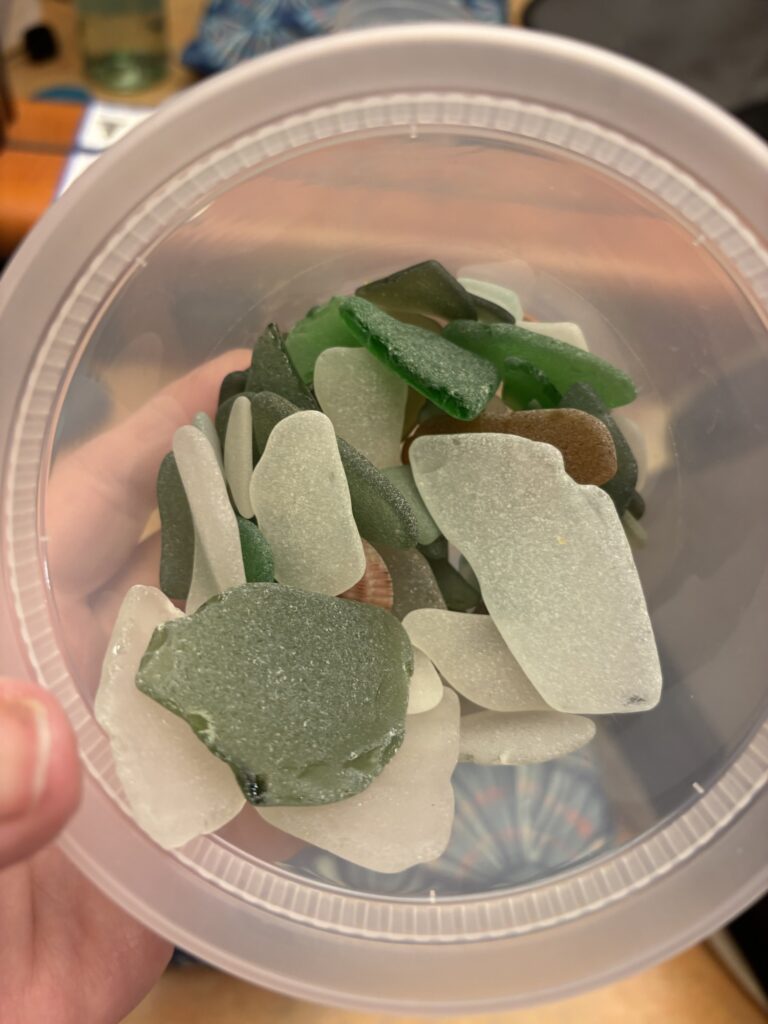
And if you find sea glass? That’s a different story. You can collect sea glass at both places based on our experience.
Check current park regulations before collecting, since rules can change.
🎣 Surf Fishing at Both Parks
Both parks provide opportunities for surf fishing.
Delaware State Parks requires the appropriate annual surf-fishing vehicle permit for vehicle access to designated surf-fishing beaches, including areas at Cape Henlopen and Delaware Seashore. Some drive-on beach areas also have specific seasonal access and reservation requirements. (Delaware State Parks)
We’re going to save the entire surf-fishing discussion for another article because there’s enough information here for a post of its own.
🦀 And Then There’s the Crab Cake Factor
We would be remiss if we didn’t mention this. Both campgrounds are close enough to Woody’s in Dewey Beach that you can make a crab-cake run. And if you’re staying for several days? You could go more than once. Maybe even every day. We’re not judging. Some campground research requires sacrifice.
🦀
⚖️ Cape Henlopen vs. Delaware Seashore: The Quick Comparison
| Cape Henlopen | Delaware Seashore | |
|---|---|---|
| Campground setting | 🌲 Wooded | ☀️ Open/exposed |
| Shade | 👍 More | 👎 Limited |
| Privacy | 👍 More | 👎 Limited |
| Site size | Large-feeling | Decent-sized |
| Water | ✅ | ✅ |
| Electric | ✅ | ✅ |
| Sewer | ❌ | ✅ |
| Full hookups | ❌ | ✅ |
| Trails | ⭐⭐⭐⭐⭐ | ⭐⭐⭐ |
| Biking | ⭐⭐⭐⭐⭐ | ⭐⭐⭐ |
| Nature center | ⭐⭐⭐⭐⭐ | — |
| Gordons Pond | ✅ | — |
| History | ⭐⭐⭐⭐⭐ | ⭐⭐⭐ |
| Surfing | Herring Point | Indian River Inlet |
| Surf fishing | ✅ | ✅ |
| Beach | ✅ | Very wide beach |
| Fishing | ✅ | ✅ |
| Lewes access | Excellent | Good |
| Traditional camping feel | ⭐⭐⭐⭐⭐ | ⭐⭐ |
| Beach-focused experience | ⭐⭐⭐⭐ | ⭐⭐⭐⭐⭐ |
🏕️ Our Chasing 70 Recommendation: Do Both
After comparing these two parks, here’s where we land: If you have the time, stay at both.
Spend a couple of days at Cape Henlopen. Enjoy the wooded campground. Borrow a bike. Ride the trails. Explore Gordons Pond. Take the grandkids to the Seaside Nature Center. Let them touch a horseshoe crab or a skate. Check out Herring Point. Explore Fort Miles. Spend some time in Lewes.
Then move the camper to Delaware Seashore. Hook up the sewer. 😂 Head down to Indian River Inlet. Watch the surfers. Walk that huge beach. Go fishing. Enjoy the water. And then…
Go get a crab cake at Woody’s.
Because apparently that’s part of the Delaware campground experience.
The Bottom Line
The question isn’t really:
“Which campground is better?”
The better question is:
“What kind of camping do you want?”
If you want trees, shade, privacy, trails, wildlife, history and a traditional campground experience, Cape Henlopen may be more your style.
If you want full hookups, easy beach access, fishing, Indian River Inlet and surfing, Delaware Seashore may be more your style.
But if you’ve got the time?
Why choose?
Stay at both.
They’re close enough that you can experience two very different Delaware coastal camping environments in the same trip.
And when you get tired of debating which campground is better…
Go get a crab cake.
Travel more. Spend less. Chase adventure.
And apparently…
Eat more crab cakes. 🦀