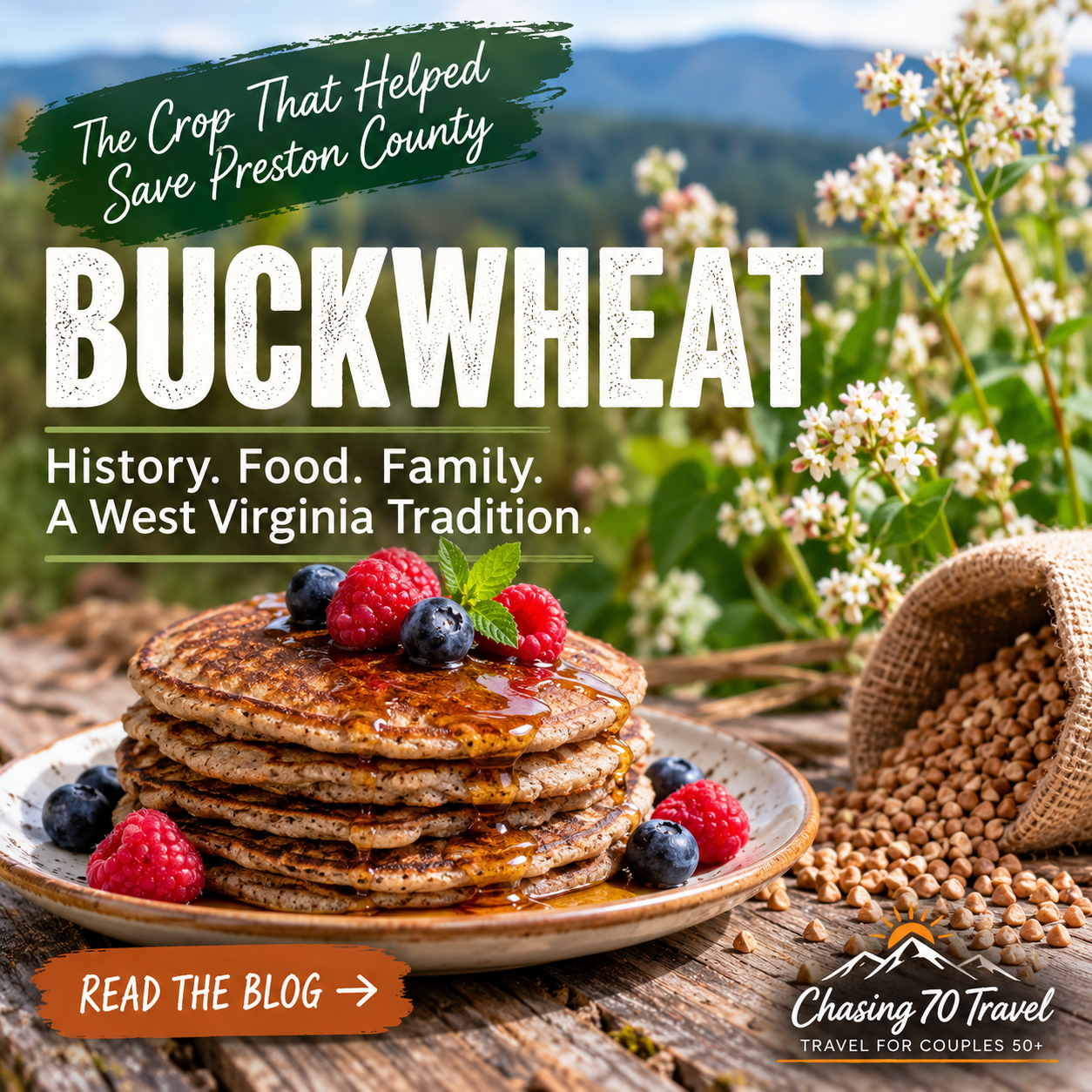
The Crop That Helped Save Preston County, West Virginia
Buckwheat: The Crop That Helped Save Preston County, West Virginia
Ask someone from Preston County about buckwheat and you might get a very different reaction than you’d get almost anywhere else. To some people, buckwheat is a pancake. To Preston County, West Virginia it is something much bigger. It is history. It is family. It is farming. It is community.
And, at one point, it may have been the crop that helped keep a really bad situation from becoming a whole lot worse. Because on June 5, 1859, Mother Nature dealt Preston County farmers a pretty terrible hand. And buckwheat was waiting in the wings.
The Big Frost
Let’s go back to 1859. Preston County was an agricultural community, and farmers depended on their crops not just for income, but for food and the survival of their households.
Then came an unusually severe frost in early June. June 5, 1859. Crops were growing in the fields. And the frost destroyed many of them.
The West Virginia Encyclopedia describes the event as a great frost that killed crops across Preston County. Farmers replanted with hardy buckwheat, which proved successful.
West Virginia Public Broadcasting describes the same event as the “Big Frost” of 1859, noting that the cold snap destroyed wheat and other crops and pushed farmers toward hardier alternatives. Imagine that for a moment. You plant your crops. You watch them grow. You are counting on that harvest. And then, in June, when you’re supposed to be looking forward to summer…
Winter comes back for a visit. Except this time it doesn’t leave much behind.
Enter Buckwheat
Here’s why buckwheat was such an important answer. It was hardy. It had a relatively short growing season. And it could be planted much later than many traditional crops.
Historical sources note that buckwheat could be planted as late as July and still produce a harvest before the growing season ended. That was a pretty big deal. The farmers didn’t have to simply throw up their hands and say: “Well, I guess we’re done until next year.” They had another option. Plant buckwheat. And that’s what they did.
Buckwheat Didn’t Arrive in Preston County Because of the Frost
This is an important part of the story.
Buckwheat wasn’t some magical new crop that appeared in Preston County on June 6, 1859.
It was already known and grown.
What changed was its importance.
After the frost destroyed other crops, farmers turned to buckwheat because it could handle the conditions and mature quickly. The West Virginia Encyclopedia says buckwheat became a staple crop in Preston County for decades after the 1859 frost. So when you hear, “Buckwheat saved Preston County,” you’re really hearing about something slightly more nuanced. Buckwheat helped give farmers a second chance. And sometimes a second chance is exactly what you need.
Why Buckwheat Was Such a Good Insurance Policy
Buckwheat had another advantage that would become important over and over again: It was dependable when conditions weren’t ideal. That made it useful as what later generations called an “insurance crop.” If another crop failed or couldn’t be planted on time, buckwheat could still give a farmer something to harvest.
During the Great Depression, buckwheat again became particularly useful to Preston County farmers because of its short growing season and hardiness. Local accounts describe it as an insurance crop that could provide food and agricultural income when other options were uncertain. That’s a pretty remarkable legacy. The crop wasn’t necessarily the fanciest. It wasn’t necessarily the most profitable. But when things went wrong…Buckwheat showed up.
From Field to Flour
Of course, growing buckwheat is only half the story. Somebody had to turn those little grains into something people could actually eat. And that meant mills. Water-powered gristmills were an important part of rural life throughout West Virginia. Farmers brought grain to the mill. The mill ground it. And flour went back home. The relationship between buckwheat farming and local mills became an important part of Preston County’s agricultural story.
Because somewhere in Preston County’s past there were: farmers planting the fields, millers grinding the grain, families cooking the cakes, children sitting at the breakfast table. And people doing all of it because that’s simply what you did.
Buckwheat Cakes Became the Tradition
Eventually, the food became just as important as the crop. Thin buckwheat cakes became a Preston County favorite, traditionally served with things like butter, syrup and sausage.
The William G. Pomeroy Foundation notes that buckwheat cakes were popularized by Preston County farmers and describes the traditional cakes as thin cakes made from milled buckwheat flour and served with syrup. And this is where a crop becomes culture. Because you’re no longer just talking about agriculture. You’re talking about what people ate. And what people ate became part of how they identified themselves.
Then Came the Buckwheat Festival
If you want proof that buckwheat became part of Preston County’s identity, look no further than Kingwood in September. The Preston County Buckwheat Festival began in 1938 as a homecoming. It has grown into one of West Virginia’s longest-running local festivals, drawing thousands of people to Kingwood. There are parades. Music. Farm animals. Crafts. Competitions. A carnival atmosphere. And naturally… Buckwheat cakes.
Lots and lots of buckwheat cakes. The West Virginia Encyclopedia reports that the festival serves more than 20,000 buckwheat-cake meals along with locally raised sausage.
That’s a lot of pancakes.
But There’s Something More Important Than the Pancakes The festival isn’t really just about food. It’s about homecoming. People return to Preston County. Families gather. Former residents come back. Communities participate. The Kingwood Volunteer Fire Department sponsors the festival, and hundreds of volunteers help make it happen. That means the buckwheat tradition has evolved. It started with a crop. The crop became food. The food became tradition. And the tradition became a reason for people to come home.
Here’s the Strange Part
Today, very little buckwheat is actually grown in Preston County compared with the crop’s historical importance. The festival remains enormous. The pancakes remain beloved. The tradition remains strong. But the crop itself is no longer the agricultural powerhouse it once was. The West Virginia Encyclopedia notes that the buckwheat used today is sourced from elsewhere, even though the festival and local tradition continue. That’s an interesting reminder: Food traditions can outlive the agricultural systems that created them.
And That’s Why the Buckwheat Story Matters
At first glance, this seems like a story about pancakes. It isn’t. It’s about what people do when something goes wrong. The frost comes. The crop dies. The plan doesn’t work. So you plant something else. You adapt. You figure it out. You keep going. And eventually that emergency solution becomes part of the identity of an entire county.
That’s why I think “the crop that helped save Preston County” is such a fitting way to tell the story. Not because one plant literally rescued an entire population. But because buckwheat gave farmers a hardy, fast-growing alternative at a moment when they desperately needed one.
As a kid, my husband remembers eating buckwheat cakes pretty much every morning. His family has been to the festival several times, and it’s a cherished memory. He grew up in a farming family, making hay where it didn’t seem possible to harvest, and eating food from the garden and what was hunted on the land.
The Chasing 70 Take
I love stories like this because they change the way you look at a place. The next time you drive through Preston County and see those beautiful West Virginia hills, remember: People have been working those hills for generations. They’ve dealt with harsh winters. Unexpected frosts. Bad harvests. Economic hardship. And yet somehow… They kept planting. They kept cooking. They kept gathering. They kept coming home.
And every September, people still gather around a plate of buckwheat cakes and sausage. A crop that once helped farmers recover from a devastating frost became a food that brings people home nearly two centuries later. That’s a pretty good story for a pancake.
Chasing 70 Travel – Travel More. Spend Less. Chase Adventure.
And when you’re traveling through West Virginia… Don’t just look at the mountains. Taste the history, too.